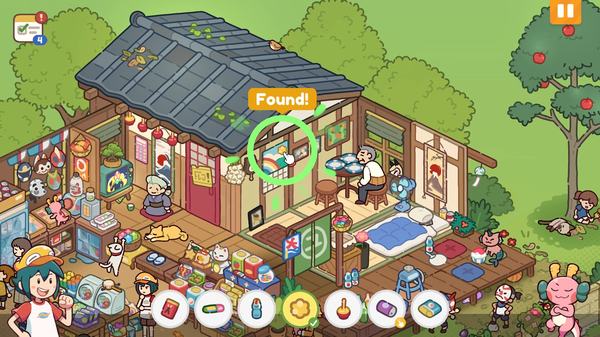
How to play: the four-phase loop
Every request runs brief, sweep, turn in, upgrade. The To-do panel is the only scoreboard: the achievement fires when the whole request is at 100%, not when the story scene ends.
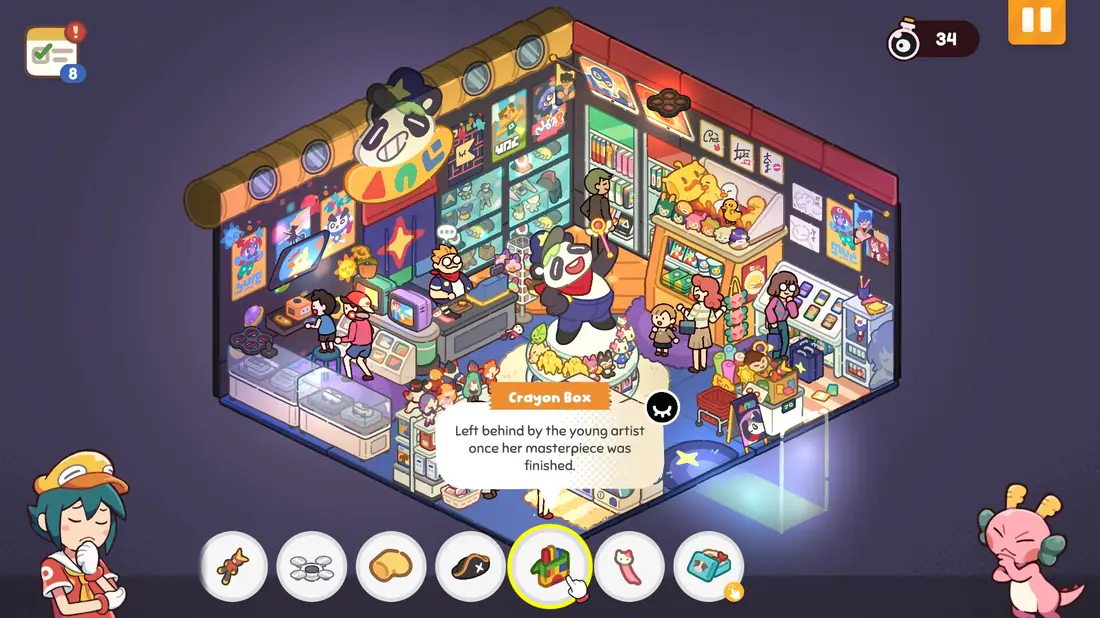
Lost and Found Co. runs on a loop that never really changes: take a request, sweep the scene, hand the objects back, spend what you earned. What changes is the scale. Early requests are one room and eight objects; Fall Update stages are multi-room buildings with side quests layered on top, and the 31st request expects you to know every trick the game has taught you.
Understanding the loop is what separates a two-hour refund from an eight-and-a-half-hour clear — the average playtime the studio reported at the 100-day mark.
The four phases of a request
| Phase | Where you are | What you actually do |
|---|---|---|
| Brief | The office lobby | Talk to Mei or the client, accept the request, read the To-do list |
| Sweep | The stage | Click objects, open containers, find Juju, trigger the side quest |
| Turn-in | The stage, then the office | Return the main item, watch the resolution, collect the mail |
| Upgrade | Ducky's Room / office | Spend Plum Coins, place furniture, check milestones |
The brief is skippable in tone but not in information: clients describe what they lost in plain terms, and the object description usually echoes the same words.
What a single request contains
Every stage is built from the same five layers, and the To-do panel shows them as separate lines:
- The main objective. One item, usually the reason the client walked in. Finding it advances the story.
- Secondary objects. Several smaller items that belong to the same scene, required for the 100% achievement.
- A side quest. An optional chain that only opens after a specific interaction — a poster, a mailbox, a character who asks for a favour. Patch notes across 1.0.x and 1.1.x are full of fixes to these: a graffiti quest that would not complete, an energy drink quest that could not be finished, a sword objective that had to be moved.
- Juju. Grey, wobbling collectibles scattered through the scene. They are the currency for hints, not a separate completion metric.
- Instapix. Photo moments that feed the in-game social app. Some stages require two clicks to register one, a bug that 1.0.1 fixed.
If the To-do list has a line you cannot identify, it is almost always the side quest: it does not exist until you touch its trigger, and the trigger is always something in the room.
How progress works outside a stage
The office is the hub, and it has three separate progression tracks that players often confuse:
- Story progress unlocks new requests. Finish a request, watch the scene, and the next client appears.
- Milestones track hours, objects found and requests cleared, with levels that grant rewards. Patch 1.0.1 adjusted the Milestone LV.12 requirements, and 1.1.3 fixed the playtime stat that the milestone app displays.
- Ducky's Room is cosmetic. Furniture bought with Plum Coins changes how the room looks and nothing else — no gameplay bonus, no hint discount.
That last point is worth stating plainly because it changes how you spend: Plum Coins are for decoration, Juju is for hints, and neither converts into the other.
Difficulty and the challenge requests
Not every stage is a story request. The demo introduced Runaway Foxes and Tea Time Troubles as Request levels — shorter challenge stages built around one location and one objective — and the full game keeps that split. Players commonly sort the 31 stages into main-story requests and these shorter side requests.
The Fall Update stages are the most complex the game has shipped. Love After Life runs across a graveyard and a chapel with an Act 2 dialogue pass, and Fangtastic Feast puts a slime objective inside a haunted mansion. Both sit at the bottom of the global completion table — 9.6% and 8.2% of players respectively — which is expected for content that is three weeks old rather than a sign that they are unfairly hard.
Controls and comfort options
The Steam build is unusually generous with accessibility for a hidden object game, and most of it arrived after launch:
- Full controller support, including DualShock and DualSense, with an option to reverse camera and cursor sticks (1.0.7).
- A mouse-only option, so the game is playable with a single input device.
- "Playable without timed input" is an official Steam category — the timer is a statistic, not a gate.
- Colourblind mode, brightness and contrast sliders, all added in 1.0.7.
- Touch and pen support for handheld PCs (1.0.7).
- A skip button for cutscenes (1.0.8) and a "skip all" update in 1.1.3.
- Dialogue history, added in 1.2.0, so a line you clicked past can be read again.
How stages unlock, in practice
Requests unlock in a fixed order, and the order is not obvious from the stage names. The reliable signal is your To-do list: if a request is not on it, the prerequisite has not been turned in. The Fall Update pair unlocks after Smoothie Showdown — the Fall Update notes name it as the prerequisite.
One practical consequence: a walkthrough written before October 2026 may call Smoothie Showdown the last request. It is not — Love After Life and Fangtastic Feast come after it, and Fangtastic Feast is the last entry in Steam's achievement list.
If you want the mechanics of hints and collectibles next, read Juju and hints. If you want to see the loop applied to a specific stage, Runaway Foxes is the request the studio itself ranks as the easiest to clear to 100%.